Bogenzeit
A new way to read the time as a position on the Sun's arc, not as a count of hours.
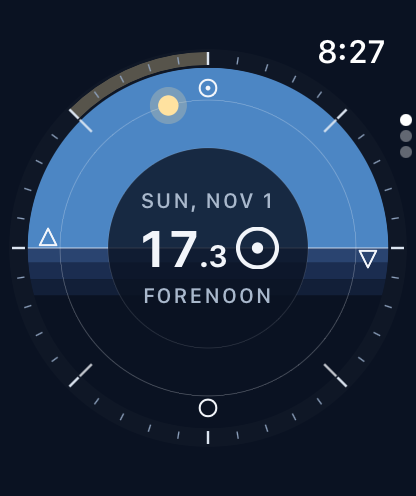
Bogenzeit, right now.
Showing Houston.
How the day works
Picture a whole day as a circle. The Sun travels around it once: up from the dark to noon, when it sits highest, then back down to the dark again.
Cut the circle in half and you have two arcs. The top half is the daytime — sunrise, up to noon, down to sunset. Its name is the Tagbogen, the day arc. The bottom half is the night — sunset, down to midnight, up to the next sunrise. That one is the Nachtbogen, the night arc.
Now cut each arc in half: that makes four pieces, the four quarters of the day.
To tell the time, you say where the Sun is on the circle: how far it stands from the nearest marker — noon or midnight — counted in spans.
The four quarters
The four quarters are words you already use. Better still, a reading names its own quarter: the glyph tells you the anchor, and the side the number sits on tells you the direction.
Daytime
- Morning — the number before the glyph, sunrise to noon
- Afternoon — the number after it, noon to sunset
Night
- Evening — the number before the glyph, sunset to midnight
- Night — the number after it, midnight to sunrise
Halve each quarter again and you have eight eighths.
The eighths
Each eighth is named for the marker nearest it — the one just behind you (an After-) and the one coming up (a Fore-). You don't need them to read the clock; they are for saying where inside a quarter the Sun is.
The day arc
- Afterrise — just after sunrise
- Forenoon — approaching noon
- Afternoon — just after noon
- Foreset — approaching sunset
The night arc
- Afterset — just after sunset
- Foremid — approaching midnight
- Aftermid — just after midnight
- Forerise — approaching sunrise
How to read it
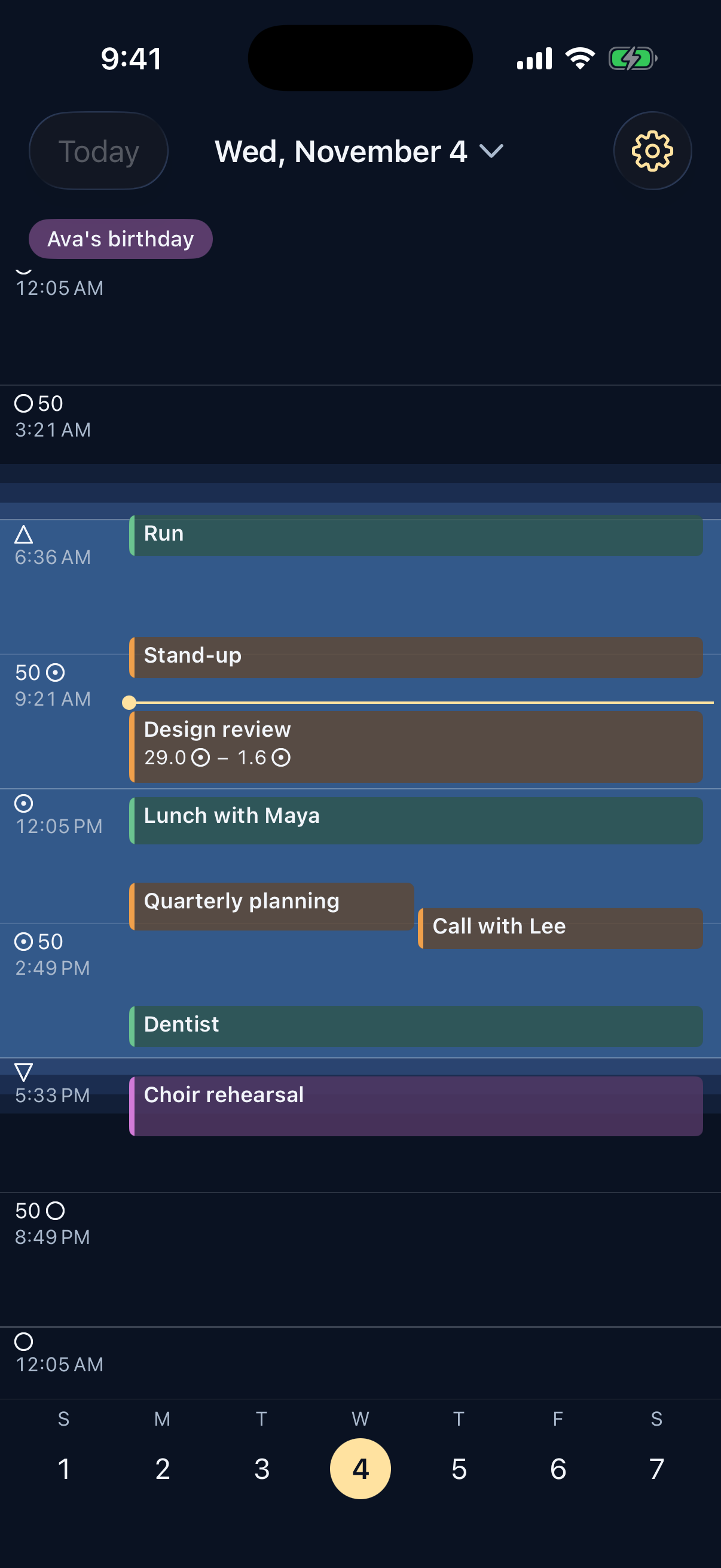
Each half of the arc is a hundred spans. A reading is how many spans you are from the nearest anchor, and which side of the glyph the number falls on says whether it is still to come or already past: 18 is eighteen spans before noon, 18 eighteen spans after. A span stretches and shrinks with the season — it measures how much of the arc is left, not how many minutes have passed — so the reading looks the same in July and December while the hours behind it change.
- Solar noon. The Sun at its highest. Spans are counted from it through the day.
- Solar midnight. The Sun at its lowest. The anchor through the night.
- Sunrise and sunset, the edges of daylight, where a half-arc reaches its hundredth span.
When you need a fixed length rather than a proportional one, the same position reads in kiloseconds — a flat thousand seconds, about 16.7 minutes — written with the unit: 3.43 ks is the same moment as 18 . Spans are the everyday reading; kiloseconds are there for when exactness matters. It is built to see and think about where you are in the solar day, not to log what you did in it.
Seeing it